FormaliSE 2018
Conference on Formal Methods in Software Engineering (June 2nd, 2018)co-located with [ ICSE 2018, Gothenburg, Sweden
Given every three years for technical achievements in advancing, applying, and promoting formal methods, the FME fellowship rewards scientific breakthroughs and pioneering work that have made a difference to the world through advances in formal methods. This includes contributions in the following areas:
The recipient of the fellowship will clearly have made a difference in one or more of these areas, and this will be supported by concrete evidence.
You are invited to attend the FME business meeting in Turin on 20 September 2017. The meeting will be hosted by the University of Torino and co-located with the Integrated Formal Methods (iFM2017) conference.
Please refer to the agenda for more information.
The minutes from the previous FME business meeting in London are available on the FME web site.
Best regards,
Lars-Henrik Eriksson
FME Secretary
Call for proposals for workshops co-located with
FM 2018: 22nd International Symposium on Formal Methods
Oxford, UK, 15-17 July, 2018
The 23rd International Symposium on Formal Methods (FM 2018) will take place at the University of Oxford, 15-17 July 2018, as part of the Federated Logic Conference (FLoC) 2018. FM 2018 is the latest in a series of symposia organised by Formal Methods Europe, an independent association that encourages the use of, and research on, formal methods for the engineering of computer-based systems and software. The symposia have been notably successful in bringing together researchers and industrial users around a programme of original papers on research and industrial experience, workshops, tutorials, reports on tools, projects, and ongoing doctoral work.
The 2017 FME Annual General Meeting will be held on the premises of the British Computer Society in London on Thursday, May 4, at 15:30. Refer to http://www.bcs.org/content/ConWebDoc/57129 for more information.
The agenda and AGM documents are available here.

*Reiner Hähnle*
After the meeting, at 18:00, there will be a joint FME/BCS-FACS seminar by Prof. Dr. Reiner Hähnle, TU Darmstadt, Germany, who will speak about “The KeY Formal Verification Tool“. Refer to http://www.bcs.org/content/ConWebDoc/57115 for more information
Call for Proposals
23th International Symposium on Formal Methods
World Congress Autumn 2019
Formal Methods Europe (FME) is a worldwide association bringing together researchers and practitioners in formal methods for developing computing systems and software. We aim to encourage both research and application by disseminating research findings and industrial experience through symposia and sponsored events.
FME organizes a symposium every 18 months approximately. Each symposium attracts participants from all over the world. The 21rd such symposium (fm2016.cs.ucy.ac.cy) has taken place at Cyprus, November 2016. The 22nd symposium will be in Oxford, July 2018 as a federated event of FLoC. Now we invite proposals from any group or institution wishing to host the new major event in 2019.
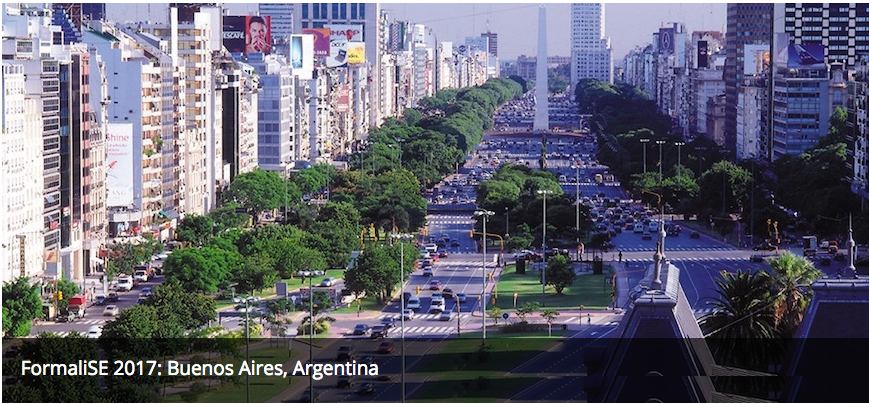
FormaliSE 2017, the 5th FME Workshop on Formal Methods in Software Engineering, will be co-located with ICSE, 20–28 May 2017, in Buenos Aires, Argentina
FormaliSE is a yearly workshop on Formal Methods in Software Engineering. FormaliSE is organized by FME (Formal Methods Europe). FormaliSE 2017 will be organised on 27 May 2017, co-located with ICSE in Buenos Aires, Argentina. The main goal of the workshop is to foster integration between the formal methods and the software engineering communities. The lack of formalization in key places makes software engineering overly sensitive to the weaknesses that are inevitable in the complex activities behind software creation. This is where formal methods (FMs) have a huge opportunity.
The FME Lucas Award goes to Jeremy Dick and Alain Faivre for their paper
Automating the generation and sequencing of test cases from model-based specifications
published at the First International Symposium of Formal Methods Europe (FME’93).

Jeremy Dick receives the Lucas Award
The FME Awards Committee motivated its decision as follows:
Dick and Faivre’s paper is a ground-breaking contribution to automation of testing based on formal specifications, a successful line of research that have added further value to the development of a formal specification. Prior to this paper, automation of testing had been developed for finite state systems and algebraic specifications. This paper presents automated techniques for model-based (sometimes called state-based) specifications, illustrated using VDM. This remarkable piece of work addressed all the aspects of a testing campaign: test-cases identification, test sequencing, generation of test values, and verification of the results against the formal specification. The core idea is the construction of a finite state automaton, using a special DNF partition of the operations domains, and then a partition of the system states. The paper has amassed hundreds of citations, and the approach has been, and is currently, widely used for quite a number of formal notations.
